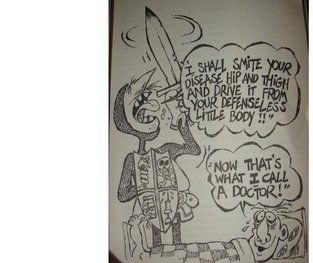
nnnnnnnnnnCartoons by Jim Storey Waiheke Island NZ


Medical research is largely or more and more being funded by drug companies - DCs.
The universities and their professors are becoming largely dependent upon DCs.
So are medical journals.
DCs are not primarily interested in the potential for harm.
They have been known to with hold information.
DCs have no interest in unprofitable treatments.
They have a duty to their shareholders not to patients.
They do what's expected of them.
Their influence is everywhere.
They need new drugs which can be patented.
Lifestyle drugs is the name of the game.
It's in their interest to have as many people as possible taking pills.
They have done great things for us but they should not control research to the extent that they do.
Guidelines are becoming a standard to judge performance and determine pay.
More and more of our top medical scientist are being helped financially by the DCs.
Too many sit on guideline committees while being paid by DCs whose products are under consideration.
Too many of our guideline producers have career conflicts of interest too.
Too many do not see these conflicts of interest as a problem.
Their mistakes and prejudices are becoming enforced on the workforce under the guise of evidence based medicine.
Tops scientists for instance should not be the ones to decide on the validity of research in their field of interest. Do the research have others crunch the numbers.
We need independent critical appraisers arguing the pros and cons of research.
Anyone being paid by a drug company should be excluded from having any a seat on anyy guidelines committee.
Evidence based medicine is a great boon and a potential trap
What is true today may not be tomorrow.
Findings may be plain wrong.
Things can be fudged.
DOEMs become more important than POEMs (disease as opposed to patient orientated evidence)
(what matters is not your cholesterol level for instance but where you have an MI stroke etc or not)
Statistical tricks can be played.
Very few doctors have the ability to sort wheat from chaff.
Critical appraisers with no conflicts of interest are a rare breed.
Once something becomes a truth it's very hard to change
Doctors are losing power to the politicians and managers.
Their livelihoods more and more dependent upon, not patients, but those that pay them and control their right to practice.
Controllers love guidelines - so would I if I was one - they simplify.
It's not their job to determine whether guideline are the truth or not.
Doing so would complicate their lives.
They tell us guidelines are only guidelines yet demand explanation if one steps out of line.
The professional and government bodies are part of this system too. They too use guidelines.
Doctors are controlled beings. If not they will be.
They are becoming less and less able to act out of their own knowledge or even the knowledge of experts that disagree with guidelines.
They are destined to become obedient souls - soldiers - unless things change.
Doctoring is becoming more and more a business rather than a profession. The yard stick - when your doctor is with you are they putting your interest before their own? Are they interested in you or more interested in their computer's requests - thats' where the money is? Ask them what's the evidence? Whats the countering evidence? What's the number needed to treat and harm? Who funded the research? Does he or she know the interaction of all those drugs she or he is offering? If you ask me, you'd get a lot of don't knows! Are you prepared for the discomfort of there being no certainty - only possibilities and probabilities
It's getting scary out there. Not too bad just yet maybe but the future looks grim to me.
Here's some of my stuff on these issues
Tight control of sugar levels in type 2 diabetes. Take a look at this for an example of differences in interpretation of evidence. As good as no benefit over less tight control
Things are not black and white. The more one knows the more Grey they become. Managers and controllers can not handle grey. Individual doctors and patients can but that's too anarchistic for the piper payers. The two people that matter in the moment are being taken bit by bit out of the game. But even for the doctors and their patients the whole business is too time consuming - better just to rely on those guidelines. Mostly they are pretty good but ......
Paranoid - yup.

We are all going to die. There are very few cures around. Most treatments these days are a matter of how many people ( a hundred) do we need to treat for one person to get a benefit. Many treatments have significant harms. Your doctor's theories may well change next year. No one knows whether you will harmed or benefitted by any particular treatment.
Getting fit, losing weight, eating nutritious foods, being loved and in love, intimacy, friendship, enjoyment, allowing yourself and others to be, not striving to be better than anyone else - all of these and more may well be more important than whether you take a statin or an asprin everyday for the rest of your life!!
If you want the best for you, you will have to be willing to deal with grey and not demand black and white answers. You will need to do your own research. You will need to be willing to take risks and make your own choices and decisions.
Know that you are a pawn and so is your doctor. Who is in control? No one really. Everyone is doing what they think is expected of them. Follow the dollar!
No solution really - sorry.
The takeover of the medical profession by managers and bureaucrats over the last ten year has been quite extraordinary and shows no signs of slowing up. Why?
The takeover was inevitable and it is going to intensify. Why?
The cost of drugs and surgery are skyrocketing - many thousands of dollars per year per patient for some treatments.
Customer demand is intense. They want the latest and best. They believe in magic bullets.
Doctors are also susceptible to the latest and the best. They need to be able to do something!!
When third parties are paying the bills, the customers don't care and neither do the doctors, someone has to reign in the spend fest.
The third party payers know that zillions of customers are not benefiting much or are being harmed by many treatments. They put out information re harms and it is largely ignored. They are of course suspected of penny pinching.
Doctors become attached to their treatments even when they have been shown to be harmful. They all too often can not or won't let go or change.
Individual doctors can not keep up with the total knowledge and skills base - even specialists have difficulty in their own field.
The knowledge base is highly polluted. Vested interests, bias, egos, unwillingness to speak out, fraud and spun research fool both doctors and customers.
The ability to assess information is not easy and is extraordinarily time consuming. Evidence based medicine has its problems. The more one knows the more grey things become. Neither customers nor doctors like grey. Each person and organisation comes to the party with their particular bias.
The drug and medical technology companies have a duty to their share holders. Benefits are exaggerated and harms put aside. They have huge resources to influence. They have billions of dollars at stake. They do not have your interests at heart.
Many of the guideline bodies have medical advisers who benefit from handsome handouts from the drug and technology companies. They claim these payouts do not influence them.
The major medical journals make their living from drug company adverts and reprints. They, well some of them, admit this is a problem.
More and more research is drug and technology company funded. University departments are all too often dependent on these companies for their survival.
Those that do systematic reviews have their biases and blind spots. Even professional critical appraisers of information can not avoid bias.
The profession has to a large extent lost the right to call itself a profession. There is just too much evidence that doctors do not have patient interests before there own. Medicine has become a business a very expensive one at that - exponentially growing in cost.
Those that pay the fiddler must feel driven to do something about the above scenarios.
A growing number of potential customers who cannot participate in the latest and greatest bring political pressure to spread the 'benefits'. Yet another reason for external controls.
The result - doctors have become or are becoming pawns of government departments, insurance companies, those they work for and the suppliers of drugs and medical technology.
As guidelines and protocols become rules to be followed one has to ask do the protocol and guideline manufacturers have the patients best interest at heart. To what extent do the above companies influence and control what goes on? As individuals they probably care but they too are subject to external forces and interests. They too may fear stepping out of line.
In the end it seems to me that the doors are now wide open for the drug and technology companies to have their way. Government bodies may do their best to reduce costs and obtain maximum effectiveness but when one looks at the whole statin thing and how this is promoted and its use endlessly extended, it seems we are on a slippery slope and your doctor isn't going to be able to help.
As bad as things may have been when doctors were free to operate from their own assessment of information I see no light the way things are going. When your doctor is a corporal in the medical machinery there's not much he can do. If he or she is top brass there still isn't much they can do. They are caught up in it all.
The end result of where we are going is disempowered patients and doctors with third party payers thinking they are in control whilst being manipulated by the drug and technology companies. What's the solution? I have no idea. It's all too big for anyone to sort out. So things will bumble on until things fall apart and yet another system is promoted.
America performs huge numbers of heart operations for coronary artery disease - billions and billions of dollars are spent - patients know they have benefitted and the demand grows. Yet the stats show they actually obtain little benefit - there are exceptions of course - their results keep the whole thing going. The evidence for benefit is unimpressive. Some people are harmed. Yet both doctors and patients are keen!
Anyone got any solutions??
Blood pressure
Obesity
Osteoporosis
Deep vein thrombosis
Femal sexual dysfunction
About Suddenly sick
Seattle Times staff reporters Susan Kelleher and Duff Wilson interviewed more than 160 doctors, patients, medical analysts, regulatory officials and other experts for "Suddenly Sick."
They traveled to Europe, Canada and around the country, obtaining records and interviews with patients, officials with the World Health Organization, and doctors attending medical conferences.
The series also relied on thousands of pages of medical-journal articles, financial disclosures by researchers, cost-benefit studies by government and industry groups, Securities and Exchange Commission records, transcripts of Food and Drug Administration hearings, U.S. Patent and Trademark Office filings, and tax returns filed by not-for-profit foundations with the Internal Revenue Service.
SS: One of the SSRI antidepressants that's widely believed to be a wonder drug is Prozac. Yet your research found that the Food and Drug Administration (FDA) received more adverse reports about Prozac than any other drug. What sort of ill effects were people reporting?
First of all, with Prozac and the SSRIs that followed, their level of efficacy was always of a very minor sort. In all the clinical trials of the antidepressants, roughly 41 percent of the patients got better in the short term versus 31 percent of the patients on placebo. Now just one other caveat on that. If you use an active placebo in these trials -- an active placebo causes a physiologic change with no benefit, like a dry mouth -- any difference in outcome between the antidepressant and placebo virtually disappears.
SS: Weren't the early drug tests of Prozac so unpromising that they had to manipulate test results to get FDA approval at all?
RW: What happened with Prozac is a fascinating story. Right from the beginning, they noticed only very marginal efficacy over placebo; and they noticed that they had some problems with suicide. There were increased suicidal responses compared to placebo. In other words, the drugs was agitating people and making people suicidal who hadn't been suicidal before. They were getting manic responses in people who hadn't been manic before. They were getting psychotic episodes in people who hadn't been psychotic before. So you were seeing these very problematic side effects even at the same time that you were seeing very modest efficacy, if any, over placebo in ameliorating depression.
Click on What for more
In December 2000, the British Medical Journal published a systematic review of 52 randomized trials comparing atypical antipsychotics with older drugs, concluding there was "no clear evidence that atypical antipsychotics are more effective or better tolerated than conventional antipsychotics." The study was ignored.
In November 2003, the Journal of the American Medical Association published the results of a two-year randomized trial comparing patients on Zyprexa with patients on Haldol, concluding there were "no significant differences" between the two groups. Zyprexa had no advantage over Haldol in terms of compliance, symptoms, or overall quality of life. The study was ignored.
In October 2005, one month after CATIE was published, the Journal of the American Medical Association published a meta-analysis of 15 randomized trials of more than 5,000 elderly patients treated with atypical antipsychotics. Patients taking the drugs had a 54 percent increased chance of dying within 3 months, compared with patients taking placebo sugar pills. The study was ignored.
Click on here for even more
An ophthalmologist, who spoke to The Age on condition of anonymity, said the drug companies were teaching key opinion leaders how to "push poll" other doctors. "The opinion leaders become product champions," he says. "This is what will slowly kill the profession and its standing in the community. It has gone way beyond a couple of endorsed pens and umbrellas."
Most of us place enormous faith in our universities. We trust that they are autonomous, independent institutions committed to education, scholarship, academic freedom and the production of knowledge free from the influence of special interest groups. Right?
Wrong. In the last 25 years, the United States has given birth to a market-model university, one where professors increasingly work 'for hire.'
Each university is afraid to tighten its rules for fear that this might drive talented faculty (and industry dollars) to other schools with more lax policies. But until the top U.S. research universities collectively adopt one rigorous, uniform policy, their autonomy will continue to erode. From Health Care Renewal
Today we had a visit from a drug rep. She was promoting Seretide - known as Advair in the US. The worstpills best pills website places a "do not use" on this product. The FDA has put out a black box warning on it. From my point of view it's a last choice choice.
FDA SEREVENT Medication Guide for Patients  (6/8/2006)
In patients with asthma, LABA medicines, such as salmeterol, may increase the chance of death from asthma problems. In a large asthma study, more patients who used salmeterol died from asthma problems compared with patients who did not use salmeterol. It is not known whether fluticasone propionate, the other medicine in ADVAIR HFA SERETIDE, changes your chance of death from asthma problems seen with salmeterol.
FDA BLACK BOX WARNING FOR SALMETEROL WITH FLUTICASONE Long-acting beta2-adrenergic agonists, such as salmeterol, one of the active ingredients in ADVAIR DISKUS SERETIDE, may increase the risk of asthma-related death. Therefore, when treating patients with asthma, physicians should only prescribe ADVAIR DISKUS SERETIDE for patients not adequately controlled on other asthma-controller medications (e.g., low- to medium-dose inhaled corticosteroids) or whose disease severity clearly warrants initiation of treatment with 2 maintenance therapies. Data from a large placebo-controlled US study that compared the safety of salmeterol (SEREVENT Inhalation Aerosol) or placebo added to usual asthma therapy showed an increase in asthma-related deaths in patients receiving salmeterol (13 deaths out of 13,176 patients treated for 28 weeks on salmeterol versus 3 deaths out of 13,179 patients on placebo).
 Dig around in here to find out about drug stories and antics of drug companies. Patent holders can now pay the generic manufacturers millions not to manufacture - cool eh! One company got paid 60 odd million to hold back. Gooze news is full of stuff like this medical and non medical.
Think about statins, think about the new look alikes, but special of course in some way, being prepared for the baby boomers - think of the money. The new cancer drugs costing 10,000 per person per month.
The world needs new models for doing business. When the primary focus is profit, that's maybe fine for a company selling toys but when it comes to drugs, to health, to health foods, to medical journals the profit motive is not a good idea. Don't believe me read Gooznews and follow a few of his links.
These days it seems everyone is on the take including the doctors at the top of the tree. There's rot everywhere and it will all come down to money and or power! Yes I am exagerating but not much.
As a coal face doctor I am left with my trust in the sytem somewhat battered.
Bipolar - it's cool! When you get it, your doctor gives you mood stabilisers. They have got to be kidding. Miraculous drugs which bring you down a bit when you are too up and up a bit when you are too down. They even have kiddie books to educate the kids about it - educate!! There is an epidemic of this disease as the diagnostic gateway opens wider and wider.
Who believes this stuff!
A recent book, The Bipolar Child [32], brings out the extent of the current mania. Published in 2000, this book sold 70,000 hardback copies in six months in the US. As the Star Telegram reported in July 2000 [33], The Bipolar Child made all the difference to Heather Norris, whose mother, after reading it, challenged her physician to correct Heather's diagnosis from ADHD, treatment of which had made her daughter worse, to the correct diagnosis of bipolar disorder. As a result, Heather, at the age of two, became the youngest child in Tarrant County, Texas, to have a diagnosis of bipolar disorder.
Bipolar used to be an uncommon diagnosis. It now claims 5% of the population. Graph below shows medline search results for the term mood stabiliser by year and number of articles found.
 Disease mongering
 - they had a conference in Perth Australia on this subject not too long ago. Transcripts of the various talks are available on line - click
here.
The drug companies aren't the enemy - they do what they are supposed to do. They make money for their shareholders. It's medical opinion leaders who are the problem. Follow the $$$$s.
Overdo$edAmerica is a great read. The author Dr Abramson was a family gp for 20 odd years a few ks outside Boston. He was involved with the university teaching medical students. He gave up Gp work to find out why the medical journals he was used to relying on were publishing stuff that seemed to have the welfare of the drug companies in mind rather than the well being of people.
With his research training he was able to spot, for example, a claimed significant relative benefit which was in fact no better than placebo. Why would a journal of such repute publish this stuff? Something is going on.
The claim - a statin - lipid lowering medication - WonderDrug gives a 18% reduction of stroke. Sounds good!! (The real figure was 16%, not 18%, and 16% in this context wasn't statistically significant) Anyway over 6 years 4.5% of people who took placebo had strokes compared to 3.7% who took Wonderdrug. There is an 18% reduction from 4.5 to 3.7. I think this is how it works!! In absolute terms this means if 100 people take WonderDrug for six years 0.8 of them won't have a stroke - keep in mind that maybe this finding is a matter of chance. The cost of saving this eighth of a life was 1.2 million dollars!!!
The average age of the people in the above study was 62. In the real world the average age of men having strokes is 71 and for females it's 79. What Abramson found - patients in this study aged over 70 taking WonderDrug had 21 percent more strokes than those on placebo. WonderDrug causes more strokes in the at risk population!!! That's cool.
How about his next little goodie - for all the women in this study those taking WonderDrug had 26 percent more strokes than women taking placebo!!! That's cool too.
Abramson states that other studies show that eating fish once a week reduces risk of stroke by 22%. Controlling blood pressure reduces risk by 35 to 45 percent. Less than two hours a week of moderate exercise reduces risk of stroke by about 60%.
He takes a look at Celebrex and Vioxx, HRT and other drugs and slams how evidence is spun and twisted out of shape. Are Celebrex and Vioxx safer than good old voltaren?? The information your doctors rely on has become more and more promotional. Follow the money. Where there should be objectivity there is $$$$$$$$$$s?? It's a scary book. Buy it and find out. You thought your doctor was a front man for the drug companies - looks like he os she is!
Years ago a drug rep told me over a beer that he was working on getting the consultants in my local hospital to use drug X. They don't listen to you I told him. Those illustrious men and women have IQs way up there in the clouds. They are independent thinkers. They get their information from the journals. Maybe they do he said but we influence their prescribing habits.
He pulled out of his brief case some flashy looking graphs. These showed a steady uptick over time as he and his mates plied their skills on the doctors in various regions of England.
They think they are free thinkers, he said. But they aren't. We repeat this trick wherever we go.
Petr Skrabenek died in his fifties of an aggressive prostate cancer. He wrote three books which are free to
download here. Petr was human, imperfect I believe, and I wish he'd lived longer. The world could do with more folk like him. Right now we are in real need of BS detectors, whistle blowers and other such courageous types.
We are drowning in bad information. There are vested interests all over the place in the medical drug world. What's best for individual people and the human race all too often, it seems, comes second to profit, power and status. Corporate profit, career enhancement and the need to be able to prescribe quick fixes has resulted in polypharmacy. This has become the norm. Patients, well many of them, seem to prefer it too. The need to be able to give and receive a remedy underlies what seems, at best, like a huge waste of resources. Few of our medical leaders around the world are speaking against this crazy pill popping approach to life.

We thought that those that came before us prescribing poisons like mercury and arsenic were ignorant. How will we look in 50 or more years time?
Although some adverse drug reactions (ADR) are not very serious, others cause the death, hospitalization, or serious injury of more than 2 million people in the United States each year, including more than 100,000 fatalities. In fact, adverse drug reactions are one of the leading causes of death in the United States. Lazarou J, Pomeranz BH, Corey PN. Incidence of adverse drug reactions in hospitalized patients: A meta-analysis of prospective studies. Journal of the American Medical Association Apr 15, 1998; 279: 1200 - 1205.
Each year 41,000 older adults are hospitalized—and 3,300 of these die from ulcers caused by NSAIDs Ray WA, Griffin MR, Shorr RI. Adverse drug reactions and the elderly. Health Affairs 1990; 9: 114 - 122.