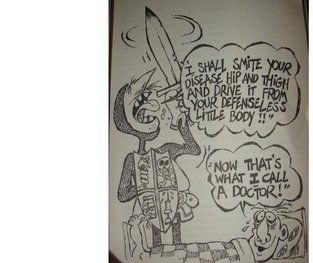
nnnnnnnnnnCartoons by Jim Storey Waiheke Island NZ
Murray, C.S., et al, Lancet 368:754, August 26, 2006
METHODS: This double-blind, controlled British study, sponsored by GlaxoSmithKline, examined the effect of early initiation of inhaled fluticasone in 200 young children who were randomized to active or placebo treatment after two confirmed episodes of wheezing or one prolonged (more than one month) episode. Fluticasone was initiated at a dose of 100mcg twice daily; the dose was reduced every three months to the minimum required to control symptoms. The patient age at the time of randomization was 0.5-4.9 years (median, 1.2 years) and follow-up was continued until the age of five, when information was available for 173 children.
RESULTS: Upon completion of follow- up, there were no statistically significant differences between the groups in the percentage of children with wheezing in the prior twelve months or the percentage with physician-diagnosed asthma. There were no differences in the use of asthma medications, measures of lung function or airway reactivity. The active treatment group had lower median daily symptom scores and fewer unscheduled physician visits for wheezing during the third month of the study, but not during the first two months. Open-label treatment with inhaled fluticasone was permitted in children whose symptoms were not controlled after three months, and there were no significant differences between the two study groups in the percentage of children ultimately treated with open-label fluticasone.
CONCLUSIONS: Early introduction of maintenance inhaled fluticasone in preschool children with wheezing was not associated with a significant reduction in the progression to asthma or improvement in lung function by age five years. 31
Please read this review article and tell me what you make of it. The more I read the more my mind goes into contortions. How am I to work out the truth? Click on the title above. It's a bit of a tough read but when you arrive in hospital with a heart attack do you want clot busting drugs or wot. Maybe staying at home, taking an
asprin and having an
AED at the ready might be better.
Conclusion
The theoretical basis of thrombolysis (ie, the open-artery hypothesis) does not account for survival differences in randomized studies. Results of randomized trials of thrombolysis in AMI may have been confounded by lack of uniform use of aspirin, higher control group AMI mortality than prevalent today, and psychological influences due to lack of blinding in some studies. AMI registry statistics do not support the efficacy of thrombolysis in AMI. The NRMI-2 registry suggests that a significant percentage of suspected AMI patients may be inappropriately receiving thrombolytics.
Given the significant morbidity, mortality, and expense of thrombolysis in AMI, an independent analysis of the statistical data of the more than 1 million patients in the NRMI studies should be done, including adjustments for age and all the known poor prognostic factors, in order to better determine whether thrombolysis for AMI improves survival.
SS: One of the SSRI antidepressants that's widely believed to be a wonder drug is Prozac. Yet your research found that the Food and Drug Administration (FDA) received more adverse reports about Prozac than any other drug. What sort of ill effects were people reporting?
First of all, with Prozac and the SSRIs that followed, their level of efficacy was always of a very minor sort. In all the clinical trials of the antidepressants, roughly 41 percent of the patients got better in the short term versus 31 percent of the patients on placebo. Now just one other caveat on that. If you use an active placebo in these trials -- an active placebo causes a physiologic change with no benefit, like a dry mouth -- any difference in outcome between the antidepressant and placebo virtually disappears.
SS: Weren't the early drug tests of Prozac so unpromising that they had to manipulate test results to get FDA approval at all?
RW: What happened with Prozac is a fascinating story. Right from the beginning, they noticed only very marginal efficacy over placebo; and they noticed that they had some problems with suicide. There were increased suicidal responses compared to placebo. In other words, the drugs was agitating people and making people suicidal who hadn't been suicidal before. They were getting manic responses in people who hadn't been manic before. They were getting psychotic episodes in people who hadn't been psychotic before. So you were seeing these very problematic side effects even at the same time that you were seeing very modest efficacy, if any, over placebo in ameliorating depression.
Click on What for more
Today we had a visit from a drug rep. She was promoting Seretide - known as Advair in the US. The worstpills best pills website places a "do not use" on this product. The FDA has put out a black box warning on it. From my point of view it's a last choice choice.
FDA SEREVENT Medication Guide for Patients  (6/8/2006)
In patients with asthma, LABA medicines, such as salmeterol, may increase the chance of death from asthma problems. In a large asthma study, more patients who used salmeterol died from asthma problems compared with patients who did not use salmeterol. It is not known whether fluticasone propionate, the other medicine in ADVAIR HFA SERETIDE, changes your chance of death from asthma problems seen with salmeterol.
FDA BLACK BOX WARNING FOR SALMETEROL WITH FLUTICASONE Long-acting beta2-adrenergic agonists, such as salmeterol, one of the active ingredients in ADVAIR DISKUS SERETIDE, may increase the risk of asthma-related death. Therefore, when treating patients with asthma, physicians should only prescribe ADVAIR DISKUS SERETIDE for patients not adequately controlled on other asthma-controller medications (e.g., low- to medium-dose inhaled corticosteroids) or whose disease severity clearly warrants initiation of treatment with 2 maintenance therapies. Data from a large placebo-controlled US study that compared the safety of salmeterol (SEREVENT Inhalation Aerosol) or placebo added to usual asthma therapy showed an increase in asthma-related deaths in patients receiving salmeterol (13 deaths out of 13,176 patients treated for 28 weeks on salmeterol versus 3 deaths out of 13,179 patients on placebo).
Every parent in America should be made aware of a presidential initiative called the “New Freedom Commission on Mental Health.” This commission issued a report last year calling for the mandatory mental health screening of American schoolchildren, meaning millions of kids will be forced to undergo psychiatric screening whether their parents consent or not. At issue is the fundamental right of parents to decide what medical treatment is appropriate for their children. For rest of article click here
If we haven't worked out what health is and how to provide it, how in the hell are we going to know what mental health is? Guess who stands to gain from something like this??
The role of high cholesterol in predicting death from coronary heart disease could be confirmed in men of all ages and in women under the age of 50. In men, across the entire age range, although of borderline significance under the age of 50, and in women from the age of 50 onward only, low cholesterol was significantly associated with all-cause mortality, showing significant associations with death through cancer, liver diseases, and mental diseases.
So cholesterol up isn't too good for one's heart and low cholesterol is just plain bad all round. Bloody hell.